
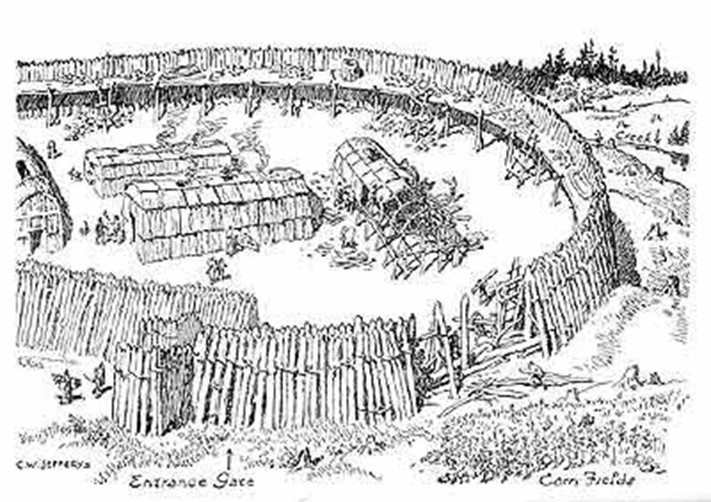
In the centuries before major European presence in this area, the primary residents of the Niagara Peninsula were the Neutrals. These Iroquoian people lived here in a complex society until being tragically wiped off the map in the mid 17th century. Sean heads to Barbican Heights, today an unassuming suburban sudivision in south St. Catharines, but 400 years ago the site of an important Neutral longhouse village. This is History from Here, a video series presented by the St. Catharines Museum and Welland Canals Centre.
The Neutrals were so called by the French due to their tendency to stay neutral in feuds between the Haudenosaunee to the east and the Wendat to the north. But these people were made up of several subnations and went by many names including “Attawonderonk” and “Ongiara” – the source of today’s “Niagara”. Like their neighbours, the Neutrals were an ethnolinguistically Iroquoian people known for living in sophisticated longhouse villages, practicing Three Sisters agriculture, and playing lacrosse. Neutral society flourished here in what is now St. Catharines for maybe a thousand years.
There were likely many villages in the area over the centuries, but the only one in the modern city boundaries that has been archaeologically confirmed was found right here in what is now the Barbican Heights neighbourhood. Artifacts had occasionally been found here over the years and, with development on the horizon, a formal study was ordered in 1979. The dig was led by William Noble, head archaeologist at McMaster University. Noble focused on a ten-acre section, but the full extent of the site cannot be determined with certainty because it is framed on two sides by Highway 406.
The team found thousands of artifacts including pottery shards, flint tools, smoking pipe fragments, and beads. Wampum from the south and metal tools of French origin were also found, confirming Neutral participation in a wide-reaching trade system. Numerous food and agricultural items were found including some 8000 animal bones as well as carbonized beans, corn, plum pits, grape seeds, and raspberry seeds – all native species that are still farmed in Niagara today.
Noble’s study concluded that this was a significant settlement which was occupied between about 1615 and 1630. Iroquoian villages usually moved every 15 years or so to allow soil and game to regenerate. This one may have contained around 30 longhouses for some 1500 residents. The longhouses here featured tapered ends, which was a different design than what has been found at other Neutral sites further west, pointing to cultural differences between communities. The dig found evidence of a surrounding palisade wall and, curiously, another wall that seems to have separated the village into two sections.
The people who lived here were likely of the Ongiara subnation, and considering this village’s size and strategic position, it may in fact have been their capital. The settlement lay at the edge of the Niagara Escarpment, positioning it at a point of military advantage, as well as near plentiful fresh, moving water and fertile soil. The ancient Indigenous highway known as the Mohawk Trail also passed right by here, placing these people on an important route that stretched from what is now Albany to what is now Detroit. The Barbican Heights village is one in a line of similar sites that have been found along the escarpment whose dates suggest that they may have been occupied by the same community as they slowly moved eastward every 15 years or so.
So what happened to the Neutrals and why don’t we hear about their dealings with Europeans or involvement in later histories like the American Revolution and subsequent land treaties and United Empire Loyalist settlement? Sadly, the Neutral nation was destroyed less than a generation after this village was vacated, and more than a century before European settlement took off in Niagara.
Archaeological evidence and contemporary accounts indicate that, in the late 1640s, invading Haudenosaunee warriors stormed in from their traditional territory in upstate New York. In less than five years, the Neutrals had completely disappeared as a distinct nation. While Europeans were not directly present, the brutal invasion was part of a broader conflict called the Beaver Wars – a series of colonial proxy wars between England, France, and the Netherlands that were all about the fur trade. The Haudenosaunee were heavily armed with English and Dutch guns, while the Neutrals, who had shunned French attempts to establish a trading alliance, were left defenseless. The Haudenosaunee, however, were themselves in a desperate state. Their population had been decimated by European disease, and they needed to keep up the supply of tradable beaver pelts to ensure their survival. They may also have been hoping to recover some numbers by assimilating the Neutrals and other Iroquoian peoples on this side of the Niagara River. Many were killed, but perhaps as many survived by becoming integrated into Haudenosaunee society.
When British settlement of Niagara took off in the late 18th century, this site, just like everywhere else, was carved up and granted to United Empire Loyalists. It was farmed for generations and its connection to the Neutrals was unceremoniously forgotten or ignored. But the Neutrals left a mark on this land that has quietly persevered through the centuries. From the routes of major thoroughfares to the local importance of lacrosse, paddle sports, and corn farming, the traditional stewards of Niagara have given us much, and we may have lessons to learn from their story still.
Discover more from St. Catharines Museum Blog
Subscribe to get the latest posts sent to your email.
Always great to hear about a lost part of our history. This dig, at what is usually called the Thorold site, tends to be a rare subject for discussion, so I am really glad to see it highlighted so accurately and thoroughly. Thanks very much, Sean.
in my view, this is award-winning research and writing for a relatively small museum. I read my newsletter from you faithfully because I always learned something new.